There’s no shortage of opinions in the overlanding community on this one, and most of them involve someone telling you that you absolutely need HAM, no questions asked — usually right before they disappear into an explanation of antenna theory that you didn’t ask for. Here’s our take, without the lecture.

The Comet CA-2X4SRN0 mounted on the hood of the Jeep. GMRS covers group trail comms. HAM handles everything else — repeater access, APRS beaconing, and the kind of range that matters when you’re legitimately remote.
This antenna covers frequencies for FRS/GMRS, UHF & VHF (not all do) and why it is our choice.What the Difference Actually Is
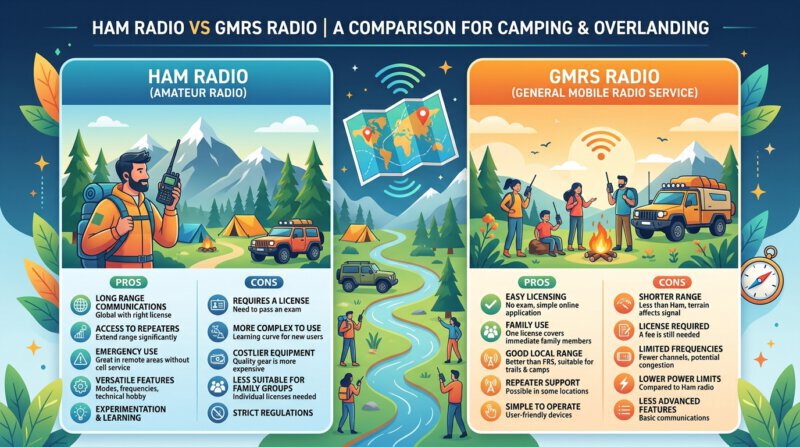
GMRS (General Mobile Radio Service) is point-to-point voice communication. You buy a radio, you get a cheap license — no test, just a fee, covers your whole family for 10 years — and you’re on the air. Most of the overlanding community runs GMRS for trail communication because they’re simple, rugged, and everyone in your group can figure them out in five minutes.
HAM (Amateur Radio) requires passing a license exam. Not hard, genuinely. The Technician exam is multiple choice and anyone can pass it in a weekend of studying. What you get in return: access to a much wider range of frequencies, higher power limits, the ability to use repeaters for extended range, and a whole infrastructure of communication that functions when cell networks don’t.
License Requirements — Quick Reference
HAM Technician: Around $50, ~afternoon of study. ARRL publishes the full question pool free online. Test sites at arrl.org/find-an-amateur-radio-license-exam-session.
Get both. They solve different problems.
So Which One?
For trail communication — the stuff you’re actually doing day-to-day — GMRS is fine. Your whole group needs to be on the same frequency, you’re not going to be talking to anyone more than a few miles away anyway, and simplicity matters when someone’s front tire just fell off. A downside is that many people run GMRS (SXS, off-road clubs/groups) and in some OHV areas and popular parks/BLM you may be sharing radio traffic with others.
Where HAM earns its place is in the bigger picture. Multi-day remote runs, especially in areas with no cell coverage: HAM gives you access to APRS (Automatic Packet Reporting System — GPS position beaconing, essentially) and local repeater networks that can relay your position or a distress call well beyond radio line-of-sight.
What We Run

Because there’s no single standard across the community, you often end up running multiple radios to keep up with whatever the rest of your group has.
GMRS and Ham tends to be the two standards these days. CB radios have fallen off in usage as GMRS is a simpler entry point and easy to use (FM makes it sound very clear).Our rig runs both. The GMRS handheld radio handles day-to-day group comms. The HAM radio handles everything else. Is that overkill for a weekend run to an established campsite? Probably. But we’ve been in enough remote spots where ‘spotty cell service’ was a generous description, and we’d rather have it and not need it. Good comms are only part of the remote-running equation — make sure your recovery kit is sorted before you worry about which radio to buy.
Gear We Run
HAM: Icom ID-5100 for the vehicle (Dual Band, purpose-built, worth the money). BaoFeng BF-F8HP as a handheld backup — cheap, ubiquitous, works. Know your frequencies and stay legal.
The Bottom Line
Don’t let anyone make this more complicated than it is. Get a GMRS license so your group can talk to each other on the trail. Get a HAM Technician license because it takes a weekend and opens up real capabilities. Run both radios. Move on to the next problem. And when you’re actually out there using them, the trail etiquette around radio use — channel coordination, check-ins, passing traffic — is worth knowing before your first group run.
