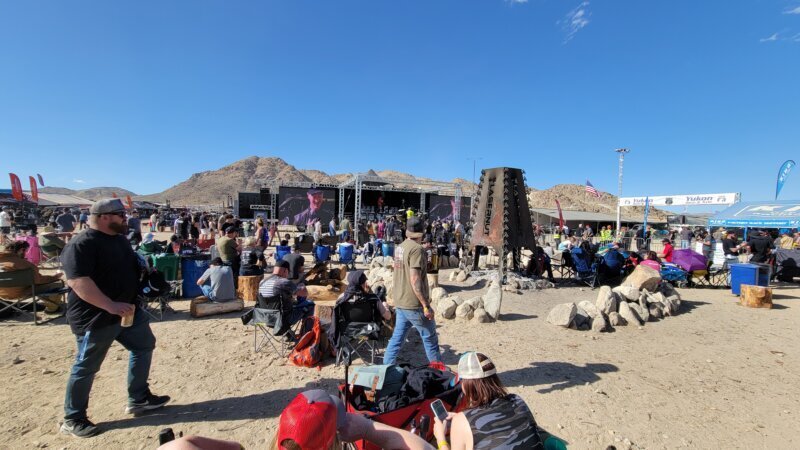
We showed up late on a Thursday night, hours after dark, and couldn’t see ten feet in front of the truck. The dust was that thick. We had no idea where to go — no reserved spot, no map that meant anything once we were off the dirt road, just open desert and thousands of other people figuring out the same thing at the same time. That’s King of the Hammers. Nobody hands you an itinerary. You show up, you figure it out, and somewhere in that figuring-out is most of the appeal.
I’ve been four times now. I’d been watching it online for a couple of years before I ever went, knew the names, knew roughly what it was, and none of that prepared me for what it’s actually like to stand in the middle of it. You can watch every YouTube recap that exists and still not get it. You have to go.
It’s Not Really About the Racing

Here’s the thing most coverage of this event gets backwards: King of the Hammers reads to outsiders as a motorsports event that happens to be in the desert. Coming at it from an overlanding side, I’d flip that. This is a multi-day trip where you live out of your vehicle in open desert, completely self-sufficient, and the racing is the entertainment they layer on top. You’re not driving in for an afternoon and going home to a hotel. You’re camping for four or five days, bringing your own water, food, and shelter, and dealing with whatever the desert throws at you — which has been everything from perfect weather to rain, snow, brutal wind, and dust that gets into every seam of every bag you own. That’s the same self-reliance mindset behind Why I Camp Alone in the Mojave and Desert Survival Skills and Emergency Preparedness, just pointed at a much bigger, much louder event.
What It Actually Is
King of the Hammers started in 2007 when Jeff Knoll and Dave Cole put the idea together — the story that gets repeated is that they sketched it out on a napkin in a bar. A trial run with 12 teams (the group now nicknamed the “OG13”) led into the first real race in 2008: about 50 drivers, zero spectators. Nobody was watching yet. Now it’s held every year in Johnson Valley, California — public BLM land the rest of the year — pulling something like 400-plus teams and 80,000 spectators, and it’s reportedly worth around $71 million to the surrounding area. The exact week-by-week schedule shifts slightly year to year, so check kingofthehammers.com directly before you plan around specific dates. Hammerking Productions, the outfit that built the event, also built the Ultra4 Racing series around it — which is now the sport’s top tier nationally, with King of the Hammers as its marquee race.
The Machines

The vehicles are the part that doesn’t translate through a screen. Ultra4 rigs are built to do two completely different jobs in the same race: run 100-plus mph across open desert, then crawl through boulder fields at a walking pace with gear reduction as low as 100-to-1. Engines pushing up to 800 horsepower, 40-inch beadlock tires, more tube work and fabrication than most people will ever see in one place. And that’s just the race cars — walk through the parking areas at Hammertown and you’ll see just as many insane personal builds that never touch the race course. Big tires, big money, a lot of effort, built by people who just came out to wheel. It looks like a scene out of Mad Max.
Race Week at a Glance

King of the Hammers actually spans two full weeks, and it’s easy to get lost in which part is which if you’ve never been. King of the Motos — the motorcycle class — along with early qualifying runs the first week. The second week is the main spectator push: qualifying and the smaller classes fill the early days, building toward the two days that matter most if you’re picking when to show up. Friday is the Everyman Challenge. Saturday is the Race of Kings — the main event, Ultra4’s unlimited class. Those are the two big shows, back to back, and that’s when the crowds peak.

The Everyman Challenge is the more accessible side of it — a range of classes below the full unlimited build, which is part of why it draws such a specific, likable crowd: regular people who built a rig and are actually out there racing it, not just factory teams. Rudy Wetzel — Matt’s Off Road Recovery’s son — built his own rig on the dry lake bed and raced it in the Everyman Challenge, filming the whole thing for YouTube. Holley Fowler (Mischief Maker) is another name worth following if you want someone to root for before you even get there.
Hammertown

Hammertown is the part people don’t expect. It’s a fenced, wristband-only area — you pay to get in — and once you’re inside it’s essentially a vendor show: every major off-road manufacturer with a booth, displays, product launches, a handful of overlanding and van-build vendors mixed in if that’s more your speed, and a general store where I’ve bought more King of the Hammers t-shirts and sweatshirts than I probably need. There’s food — the cowboy taco is worth tracking down.

The best part of Hammertown, though, is that teams have to bring their rigs through for tech inspection, so you end up walking past the actual race cars and drivers at close range, no barrier, no roped-off VIP area. And everywhere around it, personal vehicles are just parked — some of the most extreme builds you’ll ever see, owned by people who aren’t even racing. It’s dusty in a way that’s hard to describe until you’ve lived it. You will be covered, head to toe, in a fine gray layer by the end of the weekend. If you’re camping in an RV, count yourself lucky — at least you get a shower option once in a while.
Where to Camp and Watch

Where you stay is entirely up to you, and that’s either the best or most overwhelming part of the event depending on your personality. My first year, we camped right in the middle of everything — maximum dust, maximum chaos, people constantly moving in every direction. Since then I’ve camped out near the remote pits, past the edge of Hammertown proper, where a group of overlanders sets up their own informal camp most years — vendors, van builders, people cooking food, a real community feel. I like it out there, with one caveat: there’s high-speed traffic cruising through late at night, and it’s genuinely something to be careful of.
The move that’s worked best: camp close enough to the race course itself that you wake up and the race is already happening in front of you. We’ve watched the Everyman Challenge start from camp with coffee in hand, no need to go anywhere, then packed up and driven over to Chocolate Thunder — one of the course’s well-known technical sections — to watch racers work through it. Same plan Saturday for the Race of Kings: watch it from near the start, only five or ten minutes into the race, then head to Chocolate Thunder again for the technical side of it.

Chocolate Thunder at night is its own thing entirely. Across the desert you’ll see a stream of taillights all heading the same direction after dark — hundreds of vehicles converging and parking around a natural rock amphitheater to watch racers attempt a genuinely brutal rock garden trail. Some make it clean. Some flip. The crowd reacts either way. It’s a spectacle, and it’s worth experiencing at least once.
Chocolate Thunder Has No Traffic Rules
Going Alone vs. Going With a Crew
I’ve done both at King of the Hammers — with friends and solo — and the solo trip is the one I’d point people toward if they’re on the fence about going because they don’t have anyone to go with. Going with friends means better stories and someone to laugh with in the moment, but going alone meant running entirely on my own schedule, and there was something genuinely good about that. Don’t skip this event just because nobody else wants to go.
What to Actually Bring
King of the Hammers isn’t a casual day trip. Go in expecting four or five days of full self-sufficiency: your own water, food, and shelter, weather that can swing from perfect to genuinely rough, and dust that gets into everything you own whether you like it or not. It is not for the faint of heart. But the trips that ask the most of you are usually the ones you remember the longest, and this is one of those. If you go once, plan on it becoming a habit — for a lot of people, it turns into a yearly pilgrimage.