We towed a Black Series Dominator off-road camper trailer for years, camped in a Coleman instant tent before that, and now sleep in a Crashpad swag on a cot. Having used all three, the short version of trailer vs. tent camping is this: a big off-road trailer like ours is a great base camp, but its size limits where you can take it, while a ground tent or swag goes almost anywhere. A smaller trailer changes that math, and we cover that too. Below we cover setup times, how the trailer towed on the highway versus on dirt, fuel use, where it earned its keep and where it cost us. We also pass along what rooftop tent and small trailer owners have told us, so you can compare every common camp setup in one place.
Trailer vs. Tent Camping: The Quick Version
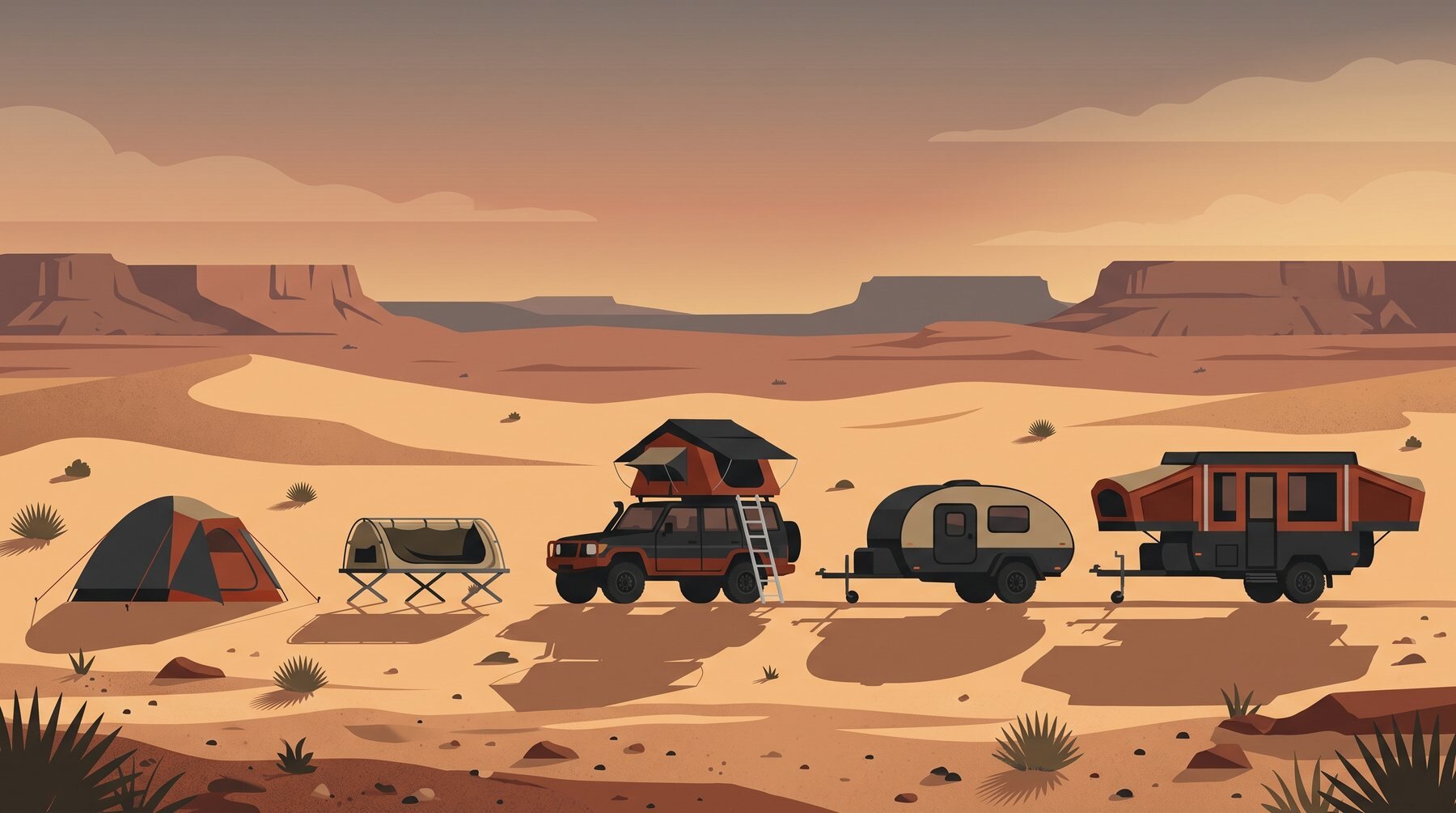
Match the setup to your most common trip, not your dream trip. If you stay put for several days, a trailer makes life easy. If you camp solo or want to go anywhere, a tent or swag is simpler and lighter. A small trailer sits in between, and size is the biggest factor.
| Setup | Setup time | Where it works | Rough cost | Our experience |
|---|---|---|---|---|
| Ground tent (instant pop-up) | About 5 minutes | Anywhere with a flat spot and room for the footprint | Low | Years of use |
| Swag on a cot | Roll it out and you’re in bed | A semi-level spot roughly 6 by 4 feet | Low to moderate | Primary setup now |
| Rooftop tent | Minutes, per owners | Anywhere your vehicle can park | Roughly $1,000 to $6,000 (retailer figures) | Not owned; we know owners |
| Small trailer or teardrop | Varies by model | Most places a small tow rig can go | Roughly $8,500 to $18,000 (typical listings) | Not owned; we know owners |
| Large off-road trailer | 5 to 10 minutes for the trailer itself; the full annex adds about 20 minutes with two experienced people, 45 to 50 solo | Wide spots with level ground | Roughly $25,000 and up | Years of use |
Prices change, so treat these as a ballpark and confirm with the maker or retailer. Black Series’ current new travel trailers start near $50,000.
Our First Setup: A Coleman Instant Tent
Before the trailer, we camped in a Coleman instant tent. You pull it out of the bag, stretch it, and it pops up and clicks into place. Five minutes tops to set up, and it tears down just as fast. It was easy for the two of us and the dogs, and it got us out regularly while we learned the region.

It also works in places you wouldn’t expect. We ran it on the sand at Oceano Dunes at Pismo Beach on a few-day trip with a big group, running the dunes during the day. After years of use it was still in great shape, and we sold it to someone looking for a cheap tent.
In the end we outgrew it, which is what pushed us toward a trailer. The other catch is real estate: a big family-size tent needs a lot of flat ground, which is more than one person needs when traveling light.
What a Black Series Dominator Gets You

We bought our Dominator, an 11 Year Anniversary edition, in 2018. Over the years we added a diesel heater and solar. It had hot water, a 75-quart Dometic fridge, a stove and a sink. Independent suspension meant that pretty much anywhere our Jeep could go, we could pull it over obstacles, within reason.

When we bought it, length was the deciding factor. We asked the dealer how long it was because it had to fit in our garage, and it just did. It lived in the garage the whole time we owned it, and the canvas was in great shape the entire time. We eventually sold it when our lifestyle changed.
If you are shopping for a trailer, measure where it will live before you fall for a floor plan. Storage at home is part of the cost.
Setting up the trailer itself: 5 to 10 minutes
The Dominator is what’s commonly called a forward fold. Once you’re parked and unhitched, the whole thing unfolds forward, the tent rises with it, and the section that flips over is where the bed is mounted. Step inside, prop up a couple of poles, and you’re done. Five to ten minutes, start to finish.
The annex doubles the space, and takes time
The annex that came with it is a beautiful, well-made canvas piece. Fully set up, with a sealed floor and roll-up windows, it more than doubles the usable space of the trailer. There was even an add-on for a small privy room if you wanted a shower or bathroom.

The annex is where the time goes. It is a lot of numbered poles that go in a particular order. Two people who have done it a few times can have it up in about 20 minutes. One person can do it alone in 45 to 50 minutes, with some swearing. Someone doing it for the first time should plan on hours. Once it clicks, it goes together easily, but you have to do it a few times first.

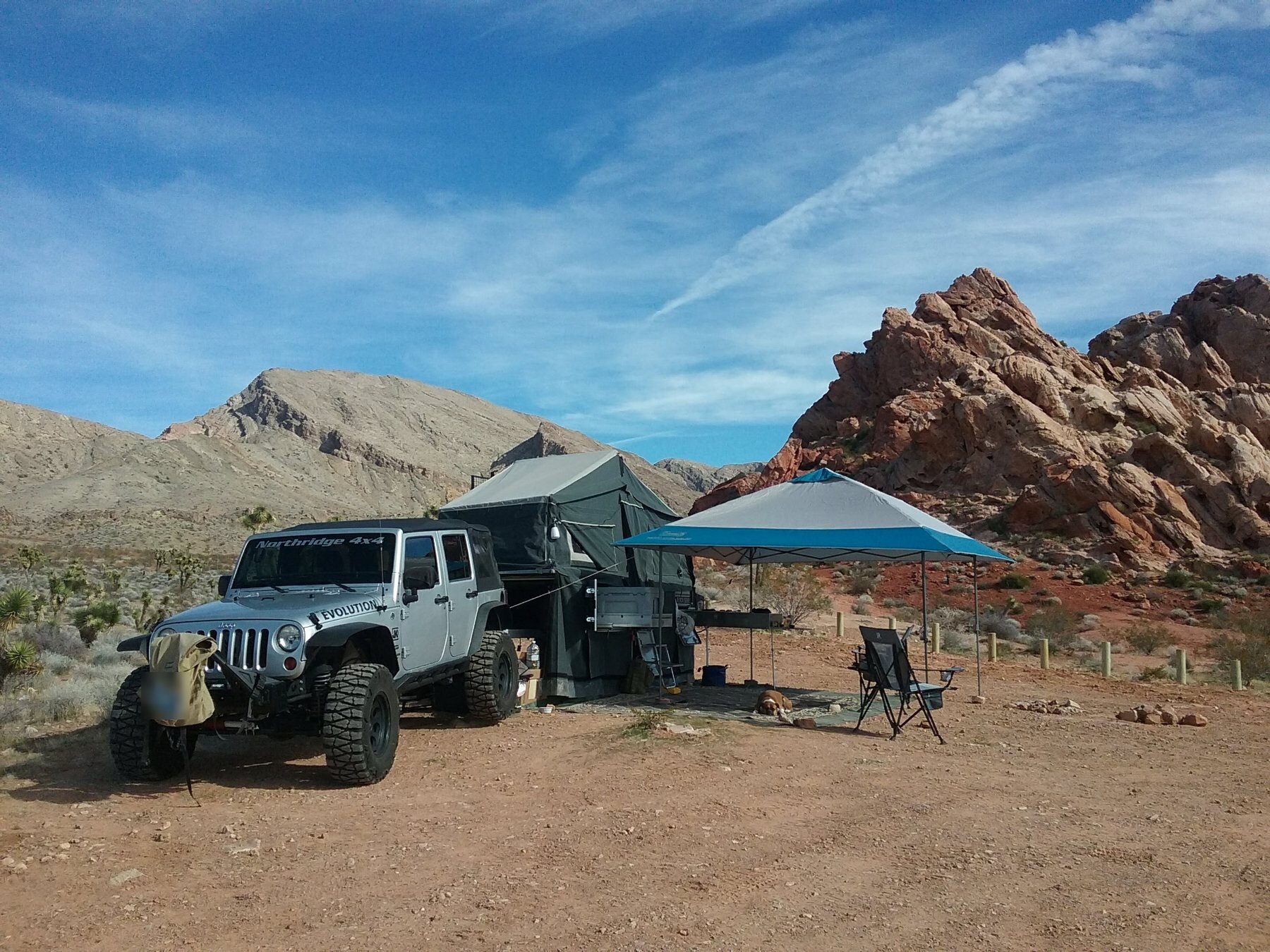
That means a full annex setup is not an overnight setup. The trailer alone is quick, so for a one-night stop we skipped the annex entirely. If you’re staying a couple of days, it’s amazing. If you’re pulling out in the morning, it’s overkill. For quick shade we ran a Coleman pop-up canopy, which took five minutes to put up and five to take down, with an outdoor rug underneath. That was the real living room. Between the canopy, the rug and a few camp chairs, we had a living room up in about five minutes without touching the annex.
Gold Butte: Where the Trailer Earned Its Keep
Gold Butte was our go-to for years with the dogs. It was easy to tow the trailer in, we were far from other people, and the views couldn’t be better. That is the trailer’s best use case: a remote basecamp where you set up once, stay a few days, and everything you need is already there. If your trips look like that, a trailer makes sense.
Where It Cost Us: Death Valley and a Road We Couldn’t Turn Around
On one Death Valley trip, the trailer did fine, but the trip around it didn’t. The available campgrounds were all full. Then we got hung up on a steep, high-elevation road with a stuck two-wheel-drive pickup on loose gravel. It couldn’t go up or down. A second vehicle came down to help pull it free and ended up stuck too, so we had to help both get moving. Getting them back up to their campground took an hour and a half to two hours.
Then we had to turn around on what was basically a single-track road. The Dominator is a long trailer, and swinging it around takes work. Luckily there was a small pull-off. By the time we got turned, it was dark, and finding a place to camp while pulling a long trailer in the dark was hard. We eventually found a spot, but it was just enough room to pull off and spend the night.
The Everyday Costs: Fuel, Weight and Level Ground
Towing, on and off the pavement. The surprise was that dirt was easier than the highway. On flat highway the Jeep towed it fine, but long steep highway grades were hard work. Off road, we could drop into lower gearing and the Jeep pulled the trailer just fine, so a rough trail was often less of a struggle than a mountain pass on the interstate.
Fuel. Fuel use went way up, especially on big elevation swings. We made sure we were fueled up before the trailhead, and a couple of times we watched the gauge with some anxiety getting out of a trail. We never measured our own mpg. As a ballpark, one towing-data source puts the mpg hit at roughly 10 to 20 percent for trailers under 2,000 pounds and 30 to 45 percent for trailers in the 4,000 to 6,000 pound range, with aerodynamics doing a lot of the work.
Weight. It’s heavy for a Jeep, and you feel every pound on a long grade.

Level ground. Remote sites are seldom flat. Ramps and levelers help, but finding a spot big enough and level enough was always a challenge. A tent is easier: we pull over and camp.
Tight sites. You’ll drive past a spot and think “I could fit in there.” Then you pull in and realize there’s no way. For small back-road camps, the Dominator was a lot of trailer. The Jeep never struggled on dirt like this. The trailer’s length was the issue, not the power.
The Swag: Why We Went Small
We found swags the way a lot of people do: watching Australian 4WD channels on YouTube, where whole crews sleep in them. We were heading out with friends to wheel and overland more often, and one of us was going out less. That meant more solo trips, so one person, one small shelter made sense.

A swag is about as simple as it gets. Roll it out and you’re in bed. All we need is a semi-level spot roughly 6 by 4 feet without a big rock in the middle, and we can set up right alongside the road. It even works with a dog: our boxer would get under the blankets and stay there for hours, because she knew that if she got out, she’d get cold. We covered the swag in depth in our Crashpad Stealth Swag review.
Rooftop Tents and Small Trailers: What Owners Report
We haven’t owned a rooftop tent or a small trailer, so we can’t give you our own setup times or mileage. We have spent plenty of time around rooftop tent owners at camp and on the trail, and we’ve had long conversations about what they love and what frustrates them. What follows is that trail knowledge, checked against what manufacturers, retailers and owners report, with sources below.
Rooftop tents.
- Pros: setup in minutes, you sleep off the ground away from mud and bugs, and good ventilation. They fit most vehicles with a rack.
- Cons: you can’t drive the vehicle once the tent is up unless you pack up first, climbing a ladder at night is a hassle, and most sleep one or two people. Soft-shell models can be noisy in wind.
- Weight and fuel: many tents weigh 125 to 250 pounds, and dynamic roof load ratings are often only 100 to 165 pounds, so check your manual. One owner reported dropping from 18 to about 15 mpg.
- Cost: roughly $1,000 on the low end to about $6,000.

Small trailers and teardrops.
- Pros: the vehicle stays free for exploring once you unhitch, you get a bed and a basic kitchen, and lighter models (roughly 550 to 840 pounds) can be towed by smaller rigs.
- Cons: you need a tow vehicle, you need storage at home, and you give up some maneuverability.
- Cost: roughly $8,500 to $18,000 for a typical off-road model.

For our own experience with a rooftop tent alternative, see Rooftop Tent vs. Ground Tent.
Who Should Buy a Trailer, and Who Shouldn’t
Trailers are tough. People see the videos and pictures and imagine a trailer will solve every camping problem. It’s a great tool, but buy the one that’s right for you. Don’t rush out and buy one. Do your research and find the right size for your needs.
A trailer makes sense if you like base camping: setting up once and staying a few days, with a family or dogs, where space and comforts matter.
A large trailer like ours is the wrong tool if you’re doing nomad-style overlanding with a lot of single track. A compact trailer such as a teardrop is a very different story and can move camp far more easily. We sometimes end up on sketchy shelf roads where the whole group has to turn around because the road is washed out or overgrown. Turning a full-size or midsize truck around on a shelf road is hard. With a trailer you’re unhitching it and figuring out how to turn it around and get down the mountain.
Size matters for tents too. A big pop-up tent is a lot of tent for one person and needs a lot of real estate. A swag needs the size of your body.
Right tool, right job. Don’t use a screwdriver when you need a hammer.
Quick Answers
Is a trailer worth it for overlanding? If you base camp for several days, yes. A big trailer is harder if you drive tight single track or want to pack up and move often, while a smaller trailer is much easier to move. A tent, swag or rooftop tent is simplest of all.
How long does an off-road trailer take to set up? It depends on the model. Our forward-fold Dominator took 5 to 10 minutes on its own. The full annex added about 20 minutes with two experienced people, 45 to 50 solo, and hours the first time.
Does towing a trailer hurt gas mileage? Yes. One towing source puts it at roughly 10 to 20 percent for light trailers and much more for heavy ones. We never measured ours, but fuel use went way up, especially on steep grades.
Do you need a special vehicle for a rooftop tent? You need a roof rack and a roof that can handle the load. Check your vehicle’s dynamic roof load rating before you buy.
Where to Learn More
- Sylvan Sport: Roof Top Tent vs Camping Trailer
- Sunday Campers: Trailer vs Rooftop Tent
- Expedition Overland: What Is the Best Overland Tent?
- Autoblog: 5 rooftop tent caveats
- 23zero: Rooftop tent weight limits
- GearJunkie: Affordable off-road trailers and teardrops
- TowRatings: Gas mileage when towing a trailer
Related reading on this site: Overlanding on a Budget, What’s In Our Rig, How to Find Places to Camp.
